Coding, Robotics & STEM: Why Early Exposure is the Future
posted on Dec 17, 2025
Gurukul The School, a highly reputed school in Ghaziabad, would like to assure you that introducing your children to technology streams like coding, robotics, and STEM is definitely a good step.
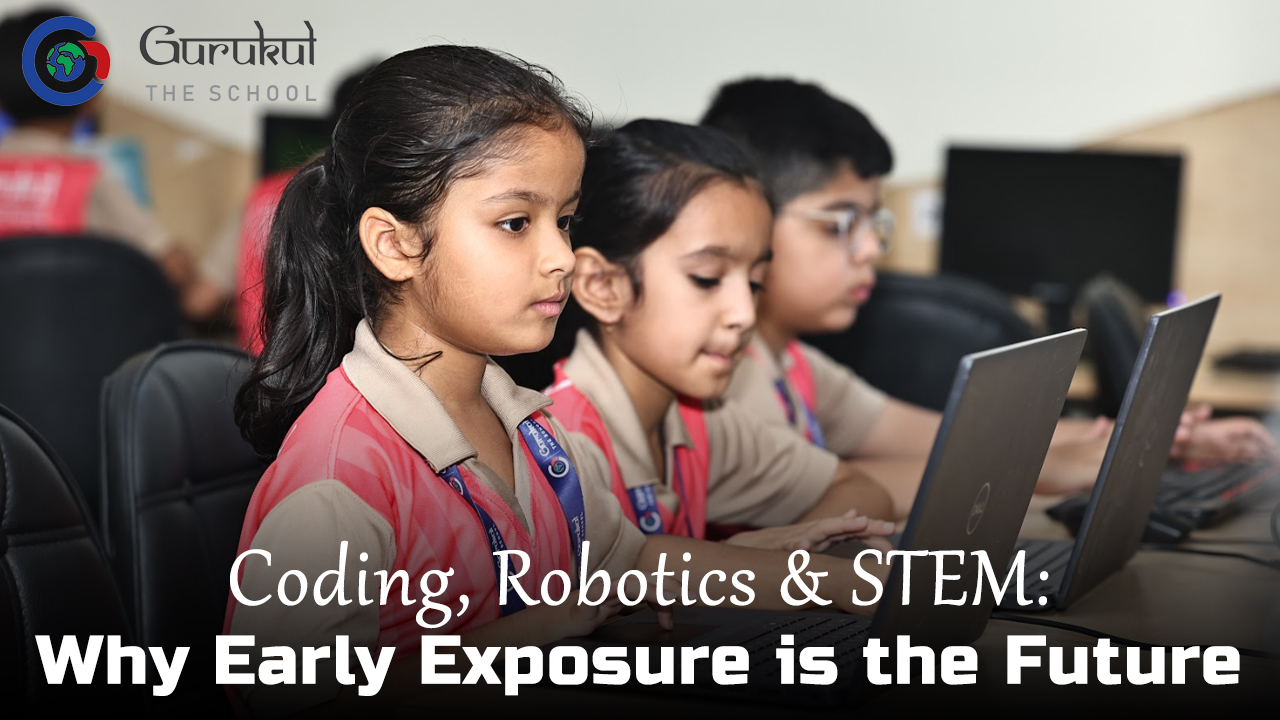
For people who took their schooling in the 80s and 90s, computers were optional. Even if you chose to avoid computers, you could still have a perfectly successful life. Today's children don't have that option. Moreover, the bar has been raised significantly higher, which means today’s children have to move beyond basic computer or technology learning.
The current environment demands technically proficient individuals, which is why modern schools are introducing students to coding, robotics, and STEM from a young age. No wonder if you begin to search for skill development programs for your children, you'll be surrounded by coding camps, robotics clubs, and STEM circles.
We understand that as a parent, it's pretty natural to wonder whether all this is just hype or if your child actually needs this. In this regard, we at Gurukul The School, a highly reputed school in Ghaziabad, would like to assure you that introducing your children to technology streams like coding, robotics, and STEM is definitely a good step. It is not about creating child prodigies or tech experts, but more about equipping them with a toolkit for thinking, creating, and thriving in a world where technology isn't separate from life anymore.
If you're still unsure why early exposure to coding, robotics, and STEM is necessary for your child's good future, the following points will clear your doubts. So, let’s quickly delve in and read on.
Coding and robotics teach something that traditional classrooms often miss, i.e., procedural thinking. When your kids build a robot prototype or write code, they cannot skip steps or guess randomly. They must think sequentially, such as what happens first and what follows next. It develops a procedural thinking mindset in children, which makes them understand the value of each step.
If your kids spend more time debugging code, their approach to handling tough homework also changes. Instead of panicking, they learn to break it down. They ask themselves questions that help them solve the problem systematically.
This process enables their brain to organise chaos into actionable steps. Even if your kids don’t know how to write codes professionally, they'll be able to use the developed thinking pattern to crack job interviews, handle tight deadlines, and even tackle career adversaries.
If you explore the current environment, you'll notice that technology isn't a career path anymore; instead, it is more like a basic foundation. By the time your kids graduate, technology fluency will become as important as core skills for any job.
In the future, doctors will use AI diagnostic tools in their practice, and architects will design home projects in 3D modelling software. Even farmers may start using data sensors to manage their crops. So, whether you choose to introduce your kids to STEM or coding, you’re making them future-ready.
Likewise, whether your child chooses to become an engineer or a creative artist, they'll need to work with technology, not around it. At Gurukul The School, we believe that an early introduction to these streams will make them comfortable with their use, building up better future opportunities for them.
There's a harsh truth that many tend to overlook. Most kids crumble at the first sign of difficulty because failure feels personal. They misunderstand struggle as proof that they're not smart or capable enough. However, regular participation in STEM activities can change how kids view failure.
When kids see that their code doesn't run or that a robot tips over, they learn that it's not because they lack intelligence. It's simply information that's trying to highlight what's missing. This mindset shift moves children from 'Why can't they do this?' to 'What needs to change?'
This process turns children into investigators, rather than victims of their mistakes. They also develop a strong emotional resilience in the process, which doesn't remain limited to robotics or coding classes. It helps them handle difficult exams, personal conflicts, and even career setbacks.
Most kids currently consume technology passively. They scroll through apps that other people have built, watch videos on platforms others have designed, and play games others have created. This makes them more like consumers of technology and not creators. However, early engagement in STEM activities can flip this script.
We at Gurukul The School firmly believe that regular participation in these activities places children on the other side of the technology, where they're active contributors, not passive consumers. Over time, it builds confidence in kids, boosting their willingness to take initiative. It opens up a whole new range of career opportunities for them, which will significantly benefit them in the future.
Conclusion
It's natural for many parents to feel that coding, STEM, and robotics are too complicated and are not meant for young kids. However, the current environment demands individuals with high-tech fluency. When kids participate in these activities from a young age, they develop a unique mindset that prepares them for tackling challenges and thriving in any situation.
Additionally, they develop stronger emotional resilience, self-confidence, structural thinking, and other modern-day skills that help ensure their long-term success. This is the reason why we at Gurukul The School, a well-known school in Ghaziabad, see coding, robotics, and STEM learning as tools that help children become problem-solvers, innovators, and resilient learners. Early exposure to coding, robotics, and STEM is not about preparing children for one specific career; it is about preparing them for a future that is constantly evolving.